
JATO · the first task, delivered
Assess an outlet. See where its stories are dying.
The first orchestrated task of the Journalistic Agentic Task Orchestration project — available now as a consulting engagement.
You bring one question — “assess this outlet, and tell me where its stories are dying.” The Audit composes a library of editorial-intelligence capabilities — merit, framing, visibility, traffic — across the publication’s own work, and returns a findings report you can act on Monday morning. It is the first task of JATO. Run from a laptop, on public data, by a journalist.
Stories don’t die from bad reporting
They die from structural invisibility. A piece that deserved to travel gets buried three clicks deep, published a day after the trend crested, framed as commodity, and never seen by the AI answer engines that now intercept roughly half of all search clicks. The newsroom rarely finds out — the intelligence that would show it pools at the top of the masthead, or doesn’t exist at all.
The assessment makes it visible. In plain English. With the fix attached.
What the assessment does
One question in; a findings report out. The Audit runs the outlet through a library of capabilities:
- Merit — the qualities internal to the text that prove non-commodity work (depth, originality, sourcing), scored story by story.
- Distribution fit — whether each story was structured, timed and surfaced to reach the readers it deserved, the AI-overview surface included.
- Visibility — how search engines and AI crawlers actually see the publication, and which sections they’ve quietly written off.
- Framing — the balance and stance of coverage, read against an established journalism codebook.
- Structure — where the site’s own architecture works against its editorial priorities.
No logins, no server access, no surveillance scripts. Public data, a short ingest, then fully offline.
What you walk away with
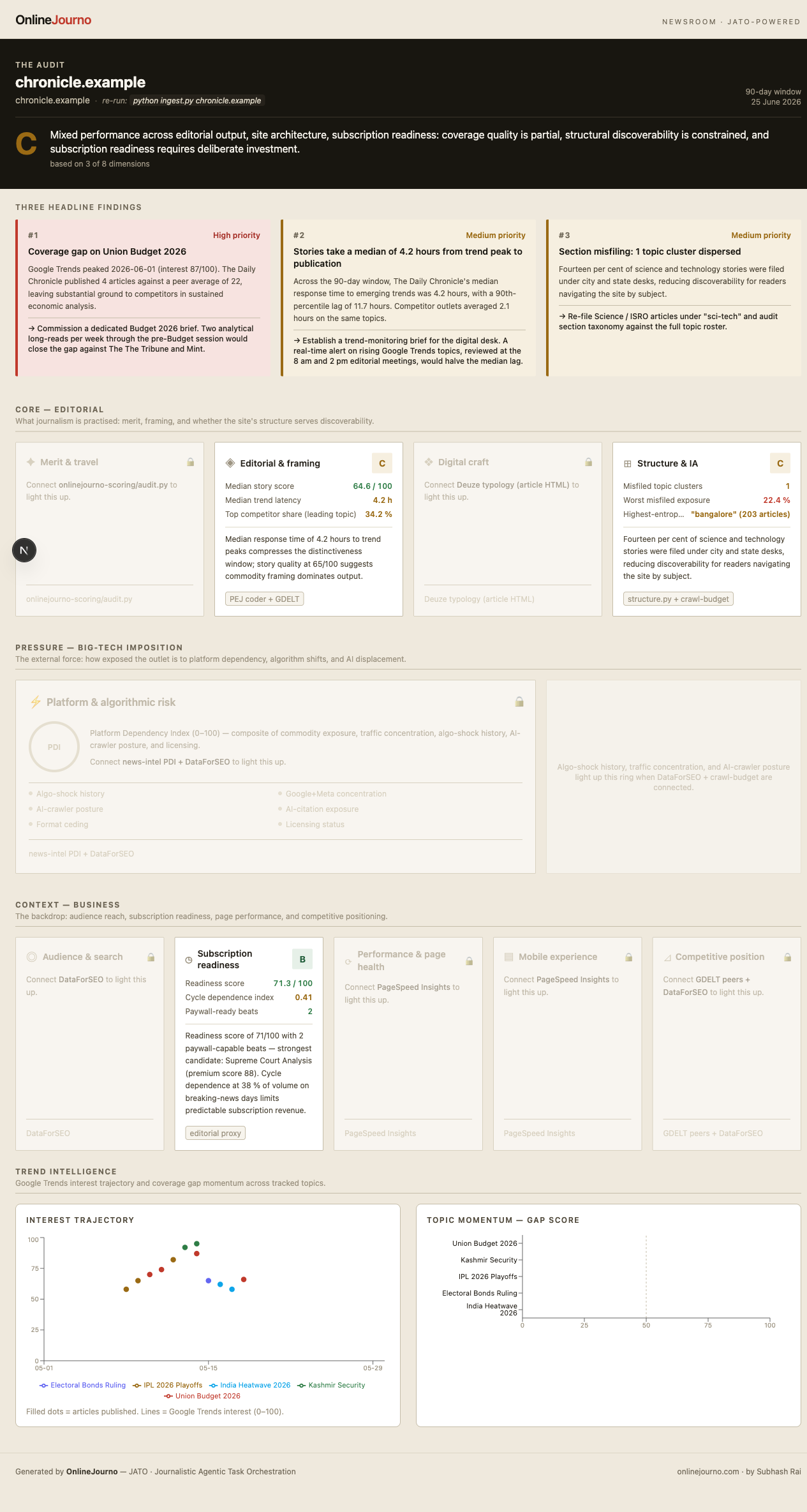
A three-ring diagnostic — Core (merit and editorial framing), Pressure (platform and algorithmic risk), Context (audience, subscription, competition). Every dimension scored, with the evidence, a plain-English implication, and a named source.
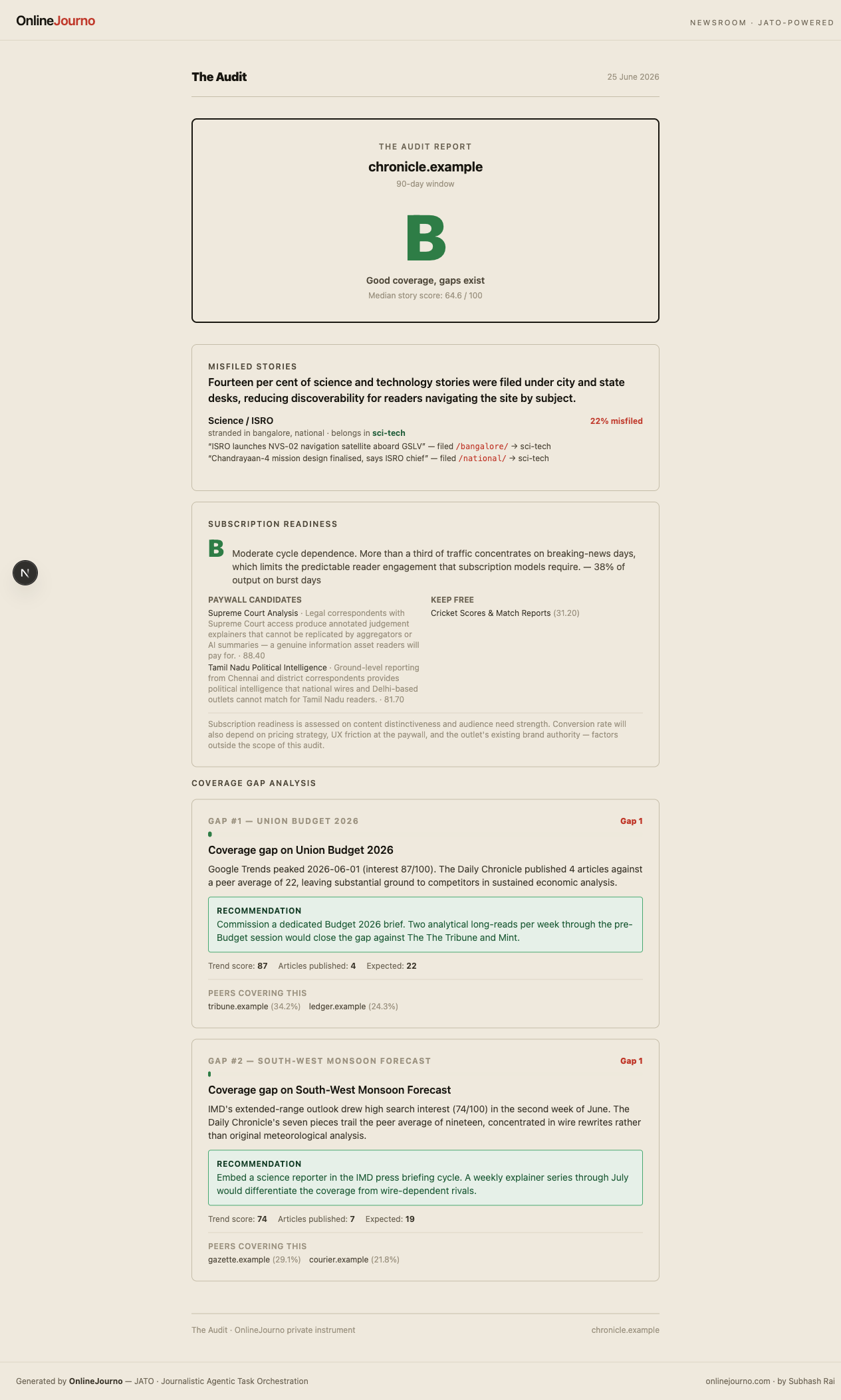
The Galley report — a graded editorial report: a cover grade, the three highest-leverage findings, and for each the why and the fix — generated as HTML, PDF, DOCX and PPTX, ready to put on the table at the editorial meeting.
Fixed price. Three findings. No retainer, no dashboard to babysit.
Why this assessment is different
- Merit-led, not vanity metrics. It scores the work, not the pageviews — because when commodity content collapses, merit is what survives.
- The reader is the subject, not the inventory. The fair-chance logic asks whether a story reached the people it was for — including the people the market cannot see.
- Decision-support, not autopilot. It surfaces the signal and the fix, with the reasoning. You and your desk decide. It never writes the story and never touches the publish button.
- By a journalist. Twenty-five years in digital newsrooms, not a vendor’s pitch deck. Vendor-neutral and fair-source — you can read every line of how it scores you.
For the consultants who bring AI to newsrooms
If you advise newsrooms, this is the instrument you walk in with. JATO is built to equip you, not replace you: you bring the relationship, the judgement and the local context; JATO does the audit, the scoring and the fair-chance analysis. It’s fair-source — read it, run it, adapt it into your own engagements, in your own language.
This is the first task, not the last
“Assess an outlet” is JATO’s first task — live today. Behind it, we’re building the JATO orchestration layer: bring any journalism task in plain language, and it decomposes the task and runs the right capabilities to answer it — with a growing library to come (buried-gem finders, claim cross-checks, regional cross-language pickup). The assessment is the front door.